
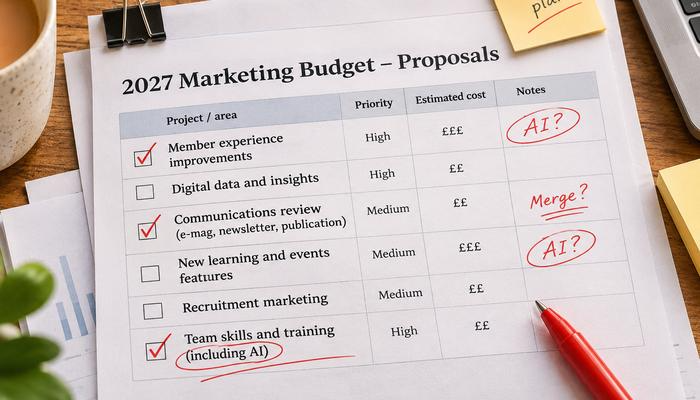
It’s budget season, so my week has mostly been spreadsheets, tea and the odd biscuit (or 3) for morale. I’ve been helping a few clients with their budgets, and in one case, every department has turned up with its own wish list. Annoyingly, they all make a good case.
The business-as-usual bit of the budget is usually tight but fine. The “good idea” list is where the numbers don’t add up, someone uncaps the red pen, and marketing gets that slightly nervous look. To some people it’s still the colouring in you do once the grown-up work is finished.
This year the red pen has a new friend: “Can’t AI do that now?” I get it. AI is changing how much a small team can get through, which is exactly why next year’s budget should include time and money for your team to learn to use it well. The tools are the easy bit. The skills are where the return is.
Members don’t see the joins
Most of what members experience happens online: joining, renewing, booking an event, hunting for that one guidance note at eleven at night. They’re usually doing it in between Netflix telling them what to watch next and their supermarket app remembering they always buy oat milk. That’s the bar.
What you deliver is only half the job. How and when it reaches people matters just as much. A brilliant new course that people hear about three weeks after booking one elsewhere hasn’t really launched. And a portal that greets everyone with the same homepage feels a bit 2012 to someone whose phone knows exactly what they like (and possibly what they had for lunch).
Getting the right thing to the right members at the right moment is marketing’s job. It’s also where AI can really earn its keep, because tailoring messages for different groups of members used to take hours, and a team that knows how to use it well can now do far more of it.
Cut marketing to protect a project and you’ve usually just made it harder to land.
Start with what it’s for
One team we’re working with has an e-magazine, a newsletter and a publication. The temptation is to skip to the fun bit: which shiny platform they should all live on. Our first question was more awkward: who is each one for, and what is it there to do? Until that’s clear, you can’t pick the right tool.
The same goes for everything on a wish list. Before anyone books a tech demo (and the pastries that come with it), ask what your members need.
Budgeting for what isn’t core
We test each wish-list idea against four things:
- Member value: does it fix something members have actually told you about? Survey comments are gold. A hunch from the away day isn’t evidence.
- Moving the dial: will it help you keep members, win new ones or bring in income? Some things are lovely and change none of those.
- Feasibility: have you got the people, skills and time? Ambition is great, and so is a team that isn’t running on fumes by March.
- Dependencies: does it quietly rely on something else first, like a system upgrade or cleaner data?
Then, for every project that makes the cut, put how members will hear about it, use it and come back to it into its own budget. Leave it as a separate marketing line and it’ll be the first thing to go, and you’ll have paid for something shiny that nobody uses. (We’ve all seen one. Some of us have the lanyard.)
Before you sign it off
Before your 2027 list goes to the board, give it one more look. For each project that really matters, check it’s clear what it’s for, that how and when members will experience it is in the budget, and that your team has the skills, AI included, to deliver it.
And if you fancy talking it through, we’re always happy to, over a tea, a video call or something stronger. It is nearly Christmas, after all…
You can find out more about how we work with membership organisations at factandfiction.london/membership.










Leave A Comment