
A perspective on deployment productivity in the membership sector
Every few years the membership sector talks itself into believing the next platform will be the one that fixes everything. Having spent a career alongside associations large and small, through the desktop era, client-server, the move to cloud, and now the arrival of capable AI, I’ve watched that hope rise and fade more than once. What’s different this time is that the advantage no longer belongs to whoever spends the most. It belongs to whoever rethinks what they’re actually buying. For association leaders, that rethink has stopped being optional.
The reason is simple. UK not-for-profits are changing their core systems less frequently and demanding far more from each one they keep. So the question that ought to dominate any software decision isn’t “what does it cost to buy?” It’s “how efficiently can we get it working, and how cheaply can we keep it working?” Most boards aren’t asking that out loud yet. They should be.
Productivity means something specific here
In commercial settings “productivity” has been stretched until it means almost nothing. Inside a membership organisation it stays concrete: stand up the systems that run the place, accurately, usefully, and with the least possible disruption to budget and staff time, and then keep them running without an endless trickle of change requests and billable consultancy.
The MemberWise Digital Excellence 2026 report frames the backdrop precisely. It records that legacy AMS and CMS replacement is still happening, but now “at a slightly slower rate than previous years.” Associations are holding on to their systems longer and living with each choice further into the future. That lengthening cycle doesn’t reduce the pressure on a deployment. It multiplies it. A botched or half-finished rollout used to be a painful one-off. Now it’s a cost the organisation absorbs year after year. And the slower pace isn’t a problem to solve; tearing out a system that works is expensive, destabilising, and more often than not driven by the wrong reasons.
Layer the financial reality on top and the picture sharpens. The report catalogues the pressures plainly: the rising cost of operating, inflation, higher taxes, relentless technological change, and members who expect more. Against that, most membership bodies put only 2% to 5% of their annual budget into technology, under the 6% to 10% the report flags as healthy, and cost is still the number-one reason organisations give for never fully integrating their systems. The brief handed to suppliers could not be clearer: more capability, lower outlay, and everything joined up.
“More for less” stopped being unreasonable
It’s easy to hear “more value, less money, less hassle” and dismiss it as wishful procurement. It isn’t. It’s a sane reaction to where associations now sit. Senior teams have to justify the value of every pound of subscription spend, even as the estate they oversee grows quietly more demanding: more data, more integrations, more channels facing the member, and a baseline expectation that all of it personalises and talks to everything else.
The report’s list of leading challenges shows the shift. They’re no longer about survival, keeping systems on, but about extracting more from what’s already there: measuring member engagement, automating administrative work, untangling fragmented databases, fixing inadequate reporting. Yet barely one organisation in ten uses anything beyond basic automation, and while AI adoption has climbed 21% since the previous report, it’s still mostly confined to website helper-bots and content search. The ambition exists. The ability to deliver it efficiently is what’s missing.
So when an association asks for more outcome at a lower total cost, that’s not greed talking. It’s a verdict on the old arrangement, buy the platform and then pay again and again to make it do the job, which no longer matches either the budget or the patience available. The suppliers who thrive now will be the ones who close that gap during deployment, not the ones who close it in the pitch.
Count the hours, not the headline
This is where a sensible instinct quietly backfires. When money is tight, the licence subscription figure is the easiest thing to line up side by side, so that’s the figure everyone fixates on. But the licence is rarely where these projects live or die. The number that actually decides the outcome is effort: the hours to configure, integrate, migrate, test and embed the thing, and then the steady stream of hours required afterwards to keep it doing something useful.
Consider the rise of solutions built on a Microsoft Dynamics 365 core, typically assembled by specialist partners stacking association-specific functionality on top of the base platform. It’s a credible approach, if an expensive and slow one, and the report confirms it has won ground among mid-sized bodies, even as a good number of the smaller suppliers behind it have since disappeared. It also makes a broader point worth saying directly: a solution welded together from a platform, plus several modules, plus partner-built extensions tends to carry more integration and configuration weight than the sum of its parts implies. That weight is real. It just doesn’t show up in the quote; it shows up during deployment, and again in year three.
Our own work at iFINITY tells the same story from the other side. We build on iMIS EMS from Advanced Solutions International, a productised platform rather than a kit of separately integrated parts. Our headline figure can land higher than a rival quote, partly because things like training, support, usage volume and API calls are bundled in rather than billed later. But our implementation hours come in consistently lower. More than once, industry consultants have assumed we must be under-quoting our project time, conditioned by the inflated estimates competitors hand them. We aren’t. The effort genuinely is lower, because coherence is designed into the product instead of charged for at delivery. That’s not a pricing trick. It’s what deployment productivity looks like in practice.
One product beats a pile of modules
The hours diverge for a structural reason. You can deliver an association solution as a single coherent product, or as a collection of modules bolted together at implementation. Both can arrive at the same destination. They don’t take the same effort to get there, and they don’t behave the same once they’re live.
A productised platform gives you one consistent data model and one uniform API across everything: membership, events, finance, communities, content. Integration gets simpler because there’s a single, well-understood surface to connect to, not a handful of module-specific ones to reconcile. Upgrades become more predictable. The set of benefits is fuller and easier to see in advance, closer to “all you can eat” than a menu where every extra capability is another integration project. That predictability is exactly what the report’s budget figures imply the sector needs but seldom factors into a decision.
The report also names the price of the alternative. It flags a recurring “worrying observation”: different teams hold different technology budgets, with membership owning the AMS and professional standards owning the LMS, and a gap between them that “can lead to poorly integrated solutions and inconsistent online member experience.” A pile of modules feeds that internal fragmentation; a unified product helps soak it up. And where satisfaction with vendors and agencies has risen, the report credits “stronger partner working” and a shift away from transactional dealings toward value-driven, medium-to-long-term relationships. Coherent products and real partnerships tend to arrive together.
The next gain: AI in the engine room
If the first productivity win comes from picking a coherent product, the second comes from changing how that product is built out and maintained, and this is where the most interesting movement is happening now. The report shows AI adoption climbing fast but still huddled at the shallow end: bots and search, with deeper “AI integration within existing systems and processes” only just starting. The real prize is moving AI off the front of the website and into the machinery of the solution itself.
That’s the idea behind AgentZ, which iFINITY is currently rolling out: an AI “MCP” for iMIS built on Cowork alongside Claude or Codex. Rather than yet another bolt-on chatbot, it behaves like a knowledgeable operator working inside the platform, because it genuinely understands how iMIS is constructed. For the consultants and resellers who deliver iMIS projects, the implication is direct: the same work, potentially in a fraction of the time.
Concretely, AgentZ can build iPARTS, the programmatic extensions that tailor iMIS to a specific client, without commissioning a costly bespoke development. It can find, diagnose and fix problems across iMIS and the iMIS RiSE CMS. Used as a console, it lets teams interrogate their data properly, surface real insight, and act on it. And it can produce the routine artefacts that normally eat specialist hours, including IQA queries, dashboards, SSRS reports, online forms and business processes, because it effectively knows how iMIS works inside out.
This is early, and it’s worth saying plainly that it’s an emerging capability, not a finished one. But the direction is the point. Building systems and chasing down faults has always belonged to senior technical staff inside an association, or to charged hours from an outside provider like us. AI as both builder and diagnostician changes who is able to do that work. Increasingly, the person talking to the software can be someone who knows a little less about the technology and a lot more about the business need, which is precisely where the value sits. Done properly, the payoff for an association is large: it goes straight at the hours that make deployment expensive, and it answers the report’s headline challenges directly, because automating admin, sharpening reporting and finally measuring engagement all come within reach once the intelligence lives inside the system rather than beside it.
What leaders actually have to change
None of this lands without a real change in how associations buy and run technology. Deployment productivity is the prize, but procurement is still wired to reward the wrong signal: the smallest figure on the page. That has to shift, and the shift starts in how leaders think before it ever reaches a budget.
Three changes of mindset do most of the work. First, compare the total cost of reaching value, not the opening quote: licence, plus implementation hours, plus the ongoing effort to keep the thing useful. A higher starting figure that needs fewer project hours and less downstream consultancy usually costs less in the end, and is almost always more predictable. Second, treat a coherent product and a uniform API as commercial assets rather than technical small print; they’re what keeps next year’s integrations and changes affordable. Third, pick a partner whose economics improve as your productivity improves, not one whose revenue depends on the work staying difficult.
That third point is the heart of it. The report’s own evidence is that satisfaction climbs with stronger, value-led, longer-term partnerships and sinks with purely transactional ones. A supplier investing in productised platforms and AI-assisted deployment is, in effect, wagering that its clients will need fewer billable hours over time. That’s a genuine alignment of interest, and it’s the relationship association leaders should be hunting for, instead of the one that simply prints the lowest number on page one.
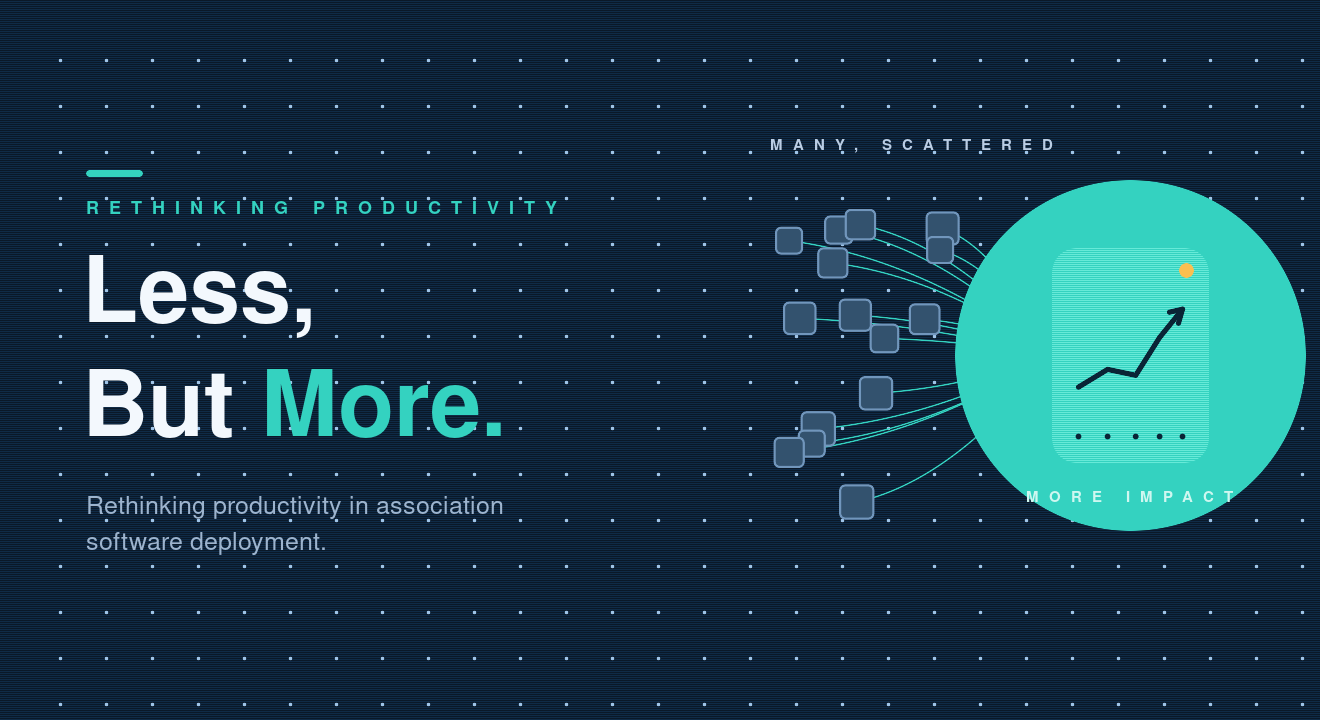
Less, but more
“Less can be more” isn’t a tagline here; it’s turning into an operating principle. The report shows associations themselves leaning into it, even treating cuts to functionality as a win where the reduced version fits members better. The same logic runs all the way down to the systems beneath the surface. Fewer moving parts, fewer integration seams, fewer billable hours, fewer nasty surprises in year three, together they add up to more value, more predictability, and more room to concentrate on members.
For any leader facing a slower replacement cycle and a tighter budget, this is the question worth sitting with. Not “what does this cost to buy?” but “how efficiently will it be deployed, run and improved, and is my supplier built to drive that number down?” Get the answer right and “more for less” stops being a demand the market pushes back on and becomes the standard it can finally hit. Doing less, but doing it coherently and for the long haul, isn’t the timid choice. In this new landscape it’s the boldest and most modern bet a leader can place.
As a leading IT systems provider for trade associations, iFINITY Ltd is dedicated to empowering organisations with the tools they require to navigate this evolving landscape. From CRM to LMS, our comprehensive solutions enable trade associations to thrive in a rapidly changing world, delivering value for their members and stakeholders. Let us partner with you to shape your association’s future.
Contact us to learn more – [email protected]










Leave A Comment