

Somewhere this month, one of your members will look at their bank statement and start cancelling subscriptions.
The streaming service they forgot about. The app they opened twice. The gym they keep meaning to go back to. Each one gets a cold look and the same blunt question: what do I actually get for this?
Your membership could be that list.
It is not a comfortable thought, but the numbers back it up. There are around 155 million active subscriptions in the UK, roughly three for every adult, and when budgets tighten every one of them gets re-examined.
Barclays’ Consumer Spend Report found that almost six in ten people worry the rising cost of these recurring payments is eating into their household finances.
When that worry hits, nothing on the list is safe. Not even you.
Why does perceived value drive membership renewals?
Because it always has. Marketing General Incorporated’s 2025 Membership Marketing Benchmarking Report, drawn from more than 450 associations, names the same culprit twice: the top reason prospects don’t join, and the top reason members don’t renew, is a lack of perceived value.
Read that word again. Perceived.
The value is often already there, sitting in a benefits programme nobody opens. Members rarely leave because you gave them too little. They leave because they never felt what they were given.
That is not a pricing problem. It’s a perception problem.
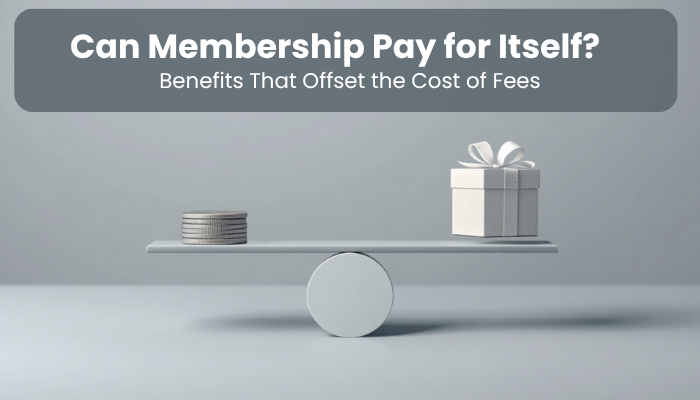
What does it mean for a membership to pay for itself?
It means the maths does the arguing for you.
Say a member pays £120 a year. If the discounts, cashback and everyday savings inside their membership hand back more than £120 across the weekly shop, the fuel, the insurance renewal and the odd big purchase, the fee has stopped being a cost.
It has become the thing that saves them money.
That flips the whole conversation. You are no longer asking a member to justify an expense. You are reminding them of a benefit they would be daft to give up.
Why do membership benefits go unused?
Organisations build the benefits, then go quiet. The savings exist, but the member never sees the running total.
Valuable benefits sit untouched because nobody flagged them, or nobody reminded the member at the moment they were about to spend. A benefit a member forgets returns nothing.
Worse, in that bank-statement moment, it reads as proof the membership isn’t earning its keep.
The fix is not more perks. It’s proof. Show the member, in pounds, what the last twelve months actually saved them.
How do member savings increase renewal rates?
A well-curated benefits programme does two jobs at once. It gives members everyday savings they would struggle to find on their own, and it hands the organisation a hard number to put in front of them at renewal.
“Your membership saved you £180 this year” beats “please renew” every time.
The organisations that win renewals are the ones that make that number visible rather than assumed.
They curate the offers members actually use, then track and surface the savings so the payback shows up in pounds, not in a vague hope that the membership feels “worth it.”
Get that right, and renewal stops being a question. It becomes the obvious call.
Because a membership that visibly pays for itself doesn’t get cut when money is tight. It’s the reason the rest of the list gets shorter.

Propello offers a range of tools to help drive new member acquisition, increase brand loyalty, boost member retention and improve the experience for your members.
Contact us to learn more.











Leave A Comment