
For membership organisations with complex operations, a bespoke CRM can feel like a realistic solution. Other systems can look too rigid before procurement has even begun, and it’s tempting to build something tailored to the exact shape of what’s needed.
The problem won’t always show up at launch. It might show up two to five years later, when the environment the system was built for has moved on. This could look like the finance platform getting replaced, an accreditation body changing its CPD requirements, or the person who understood the customisation best leaving and taking that knowledge with them.
None of this is unusual as it’s the normal life of a membership body. But in a bespoke system, every one of these changes reopens development work, and the organisation carries the long-term cost of maintaining something only a handful of people ever fully understood.
Bespoke systems can also create one kind of rigidity, but generic off-the-shelf systems can create another. The 2026 MemberWise Digital Excellence Report points to this from the other direction. The inability to automate administrative tasks is the sector’s second-biggest challenge, just behind measuring engagement.
Off-the-shelf systems built for general sales or contact management often can’t represent membership relationships accurately: for example, an individual belonging to several organisations, holding different roles, or renewing on terms that don’t fit a simple sales cycle. Teams end up automating around the system rather than through it.
Build, buy or configure
Build, buy or configure is a more useful way to think about this than bespoke versus off-the-shelf, because each one has its place depending on the process in question.
Build and buy are the easier two to rule in or out. Build makes sense when a process is genuinely unique and creates strategic value, and even then it’s usually better to build around a standard system for core tasks like member records and finance rather than replacing them outright.
Buy makes sense for well-understood processes, such as contact management or payment processing, where a mature product with a large customer base is more cost-effective than starting from scratch.
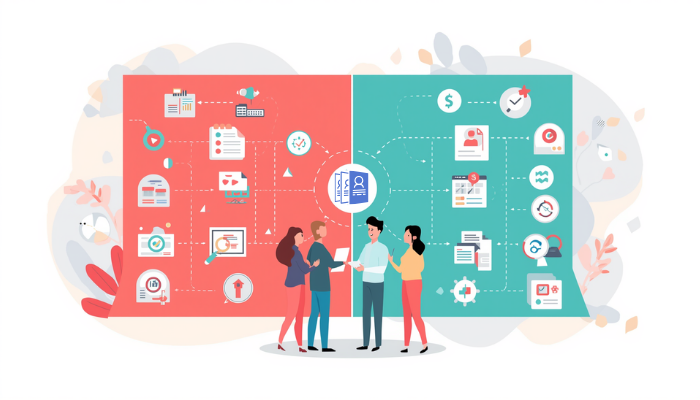
Configure is where most membership organisations actually sit. It means a system that already understands member lifecycles, renewals and events, but lets terminology, approval steps, discount rules and workflows be adjusted to fit the organisation without anyone writing custom code.
Configuring and customising get used interchangeably, but they’re not the same thing. Configuration uses tools the supplier has already built and supports: for example, changing a renewal schedule, adding a new membership grade, adjusting a discount rule.
Customisation means writing new code that sits outside the supplier’s roadmap, which means the organisation, not the supplier, becomes responsible for maintaining it every time something within the business changes. One tends to scale with the organisation, whilst the other builds up as debt.
How a membership CRM handles change
A CRM chosen well won’t just look good in a demo. It’ll still work eighteen months later, when a membership tier needs restructuring or a new starter has to get to grips with the system.
- Can a new member of staff work out how the system operates without leaning on whoever built it?
- Can reporting filters be adjusted with confidence, rather than rebuilt in a spreadsheet because nobody trusts what the system says?
- Can membership tiers, renewal rules or email journeys be updated without kicking off a new development project?
If the answer to any of these is no, the trade-off that feels safe during procurement is usually the one costing the organisation further down the line.
Read the full article on choosing between bespoke, off-the-shelf and configurable systems: Bespoke, off-the-shelf, or configurable: choosing your next membership CRM.
Choosing between bespoke, off-the-shelf or configurable is only the start. At sheepCRM, we help membership associations build systems that hold up as organisational requirements change.
Find out more or get in touch here.






Leave A Comment