
We hear many terms in data: Data Analytics, Business Analytics, Business Intelligence, Data Science, Financial Analytics. Each with their own place. But in the membership sector, there is another type of analytics that deserves a lot more attention.
Member Intelligence
When we talk about Member Intelligence, we mean going beyond the traditional reporting of knowing what members have done and starting to understand how members behave, what creates value, where risk appears and what the organisation should do about it.
When we talk about traditional reporting, we mean reporting that 200 new joiners last month, your annual retention rate is 84%, your revenue is up month on month, 600 members completed CPD, and there were 500 attendees to your events held this quarter to date. All this information is must-know and incredibly useful but Member Intelligence answers the ‘what next’ question.
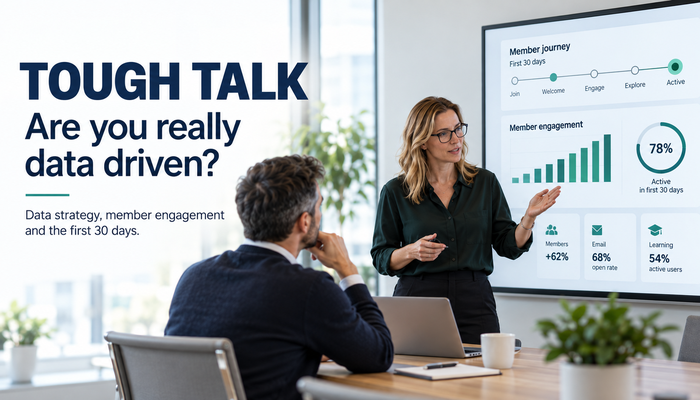
What happened to those 200 new joiners after they joined? What was their first big milestone? How many meaningfully engaged within their first 30, 60 or 90 days, what did they engage with, and did those early behaviours have any relationship with their likelihood to renew? During the first 30 days of a member’s time with the organisation they are driven by motivation, but if the onboarding is confusing, users may drop off immediately. By understanding the first 30 days you can guide the user to their first point where they realise the value of their membership.
That 84% retention rate tells you the actuals, but what is the difference between the members that chose to renew and those who did not? Was disengagement visible months before? Were there particular behaviours, or few, that were more common among members who eventually lapsed? Did new members drop off after 60 days despite showing credible engagement in the first 30?
You can apply this throughout the organisation. Rather than simply knowing how many members attended an event, Member Intelligence looks at whether they attended an event again, whether they went on to engage in learning or the community, whether different types of members behaved differently, and how their behaviour changed afterwards. It is about connecting the data rather than viewing every part of the organisation individually.
Because most membership organisations now hold vast amounts of data across their CRM, events platform, learning platform, community, marketing, website and portal. The challenge is that much of this data is still analysed within those individual areas and possibly teams. Events are reported as events. Learning is reported as learning. Marketing is reported as marketing. Membership is reported as membership. The member, however, experiences all those things as part of one relationship with the organisation.
So when you bring those behaviours together, organisations can start to identify different member journeys, understand which activities are associated with stronger engagement, find groups of members who behave differently and spot potential risk much earlier.
Segmentation
Segmentation plays a major role in this. Some members may be highly engaged across several areas, some may just engage in learning, others may be event-led, while another group may have joined but never really engaged at all. Understanding those differences allows organisations to move away from treating every member in the same way.
Member Intelligence can also use more advanced analytical techniques, including cohort analysis, behavioural segmentation, churn and retention analysis, recency and frequency analysis, member journey analysis, clustering and statistical modelling. The objective is not to make the analysis more complicated for the sake of it, but to answer better questions and get an understanding of the members’ journey. 4 years worth of data on your members could provide you with a one-off report that gives you the confidence to make decisions and invest where necessary.
Member Intelligence should help an organisation understand what happened, why it matters and what it should do next. If members meaningfully engaged within their first 60 days retain at a much higher rate, that should influence the onboarding journey. If repeat event attendees are more likely to engage with other activities such as joining a community, that should influence the event journey. If declining engagement consistently appears before members lapse, then that should influence how and when members at risk are identified.
Traditional reporting and dashboards will always remain essential, and every organisation should be able to get the answer to common questions like how many active members we currently have, how many new joiners last month or how many event attendees we have had last year versus previous year to date within just a few minutes. Member Intelligence does something slightly different: its analytics specifically to understand the members behaviour and relationship. And when membership organisations are holding years worth of data about their members, simply reporting on it may not be helping you to understand it.
Memberlytics is a specialist data and analytics consultancy dedicated to the membership and association sector. Contact us to discuss how we can help.






Leave A Comment