
Traffic is falling. Enquiries are slowing. Yet search rankings often look perfectly healthy.
This is the pattern membership digital teams are reporting across the sector. The reaction is usually the same: look for a technical problem. Fix something. Publish more.
The problem is not technical. And publishing more may be making it worse.
Why is website traffic dropping when our rankings haven’t changed?
Because the way people consume information has fundamentally changed.
68% of Google searches now end without a click to any website (SparkToro & Similarweb).
AI-generated search answers doubled in eight weeks in early 2025 (Semrush).
In other words, your content may still be helping people. They just never visit your website. For membership organisations, this lands hardest on the content you have invested in most: sector explainers, policy summaries, FAQs, best-practice guidance. These are exactly the query types AI summaries were built to answer.
Why isn’t AI-generated content solving the problem?
Many organisations responded to falling traffic by turning to AI writing tools. It is easy to understand why. The pressure to publish more, faster and cheaper is real. But this has created a second, more serious problem.
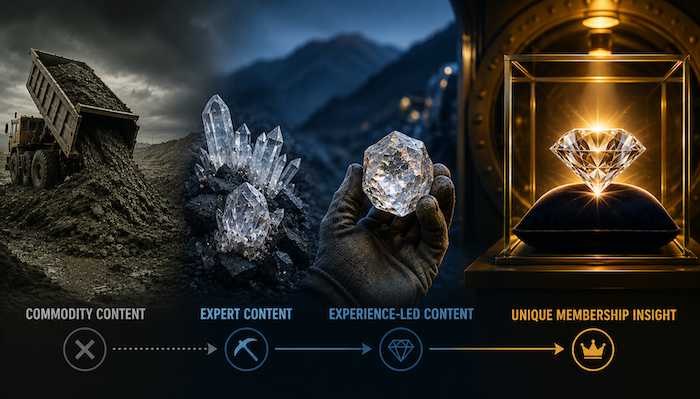
Here is what most AI content strategies miss. AI tools work by predicting the next most likely word based on patterns in content that already exists. That is not a flaw; it is how they function. But it means every article they produce is, at its core, a sophisticated variation of something Google has already indexed thousands of times.
Google’s own guidance increasingly emphasises helpful, people-first content that demonstrates Experience, Expertise, Authoritativeness and Trustworthiness. Its direction is explicit: content should provide original information, reporting, research or analysis that visitors cannot find elsewhere. If your article could have been published by any organisation in any sector, Google has little reason to rank it. Organisations that chased quick content volume are now watching Google quietly remove those pages from its index.
AI has a role. That role is research, planning and workflow efficiency. It is not a writer. It is not a strategy.
What content can only we create?
Stop asking, “What content should we create?”
Start asking, “What knowledge do we have that nobody else does?”
The answer lies within your membership community. No AI tool can interview your members. No search engine can replicate your community. No competitor can access the same combination of expertise, experiences and perspectives.
That means the most valuable content is often already inside your organisation.
“65% of members reported increased workload following recent regulatory changes, with smaller organisations most affected” is far more valuable than another generic article explaining the regulation. No language model can generate that. That is information only your organisation can provide.
Member surveys. Benchmarking reports. Salary data. Practitioner perspectives. Community discussions. Original research. Every event question, survey response and community discussion can become content that demonstrates real-world experience rather than recycled opinion. That is exactly what Google says it wants to reward.
Where should we focus our efforts?
The most resilient organisations are strengthening channels that do not depend entirely on search traffic.
Publishing to rank, then waiting for visitors to arrive is just not a reliable strategy anymore.
Email newsletters, member communities, events, peer networks, and forums are becoming ever more valuable.
These channels create direct relationships with members and prospective members, and they generate something increasingly scarce: original insight. They also reinforce the unique value of membership in a way that a blog post never fully can.
Use AI for research support, editorial planning, workflow efficiency, first-draft structuring.
Use people for insight, experience, judgement, community knowledge and the things only your sector knows.
When traffic declines, it is tempting to chase rankings. The smarter response is to build authority. Capture and sharing the knowledge that already exists within your community.
No search engine can replicate your community. Neither can your competitors. That has always been your competitive advantage. In the AI era, it matters more than ever.
 RightSource is a UK-based digital marketing consultancy founded in 2009, specialising in membership organisations, trade associations and charities.




Leave A Comment